Composition Workshop:
Ancient Kagura and Contemporary Choreography
 Taught by Susan Buirge
August 9–15, 2015
Taught by Susan Buirge
August 9–15, 2015
Bearnstow is honored to present for the first time in North America
a composition course based on the roots of ancient Japanese kagura.
|
 |
|
 |
|
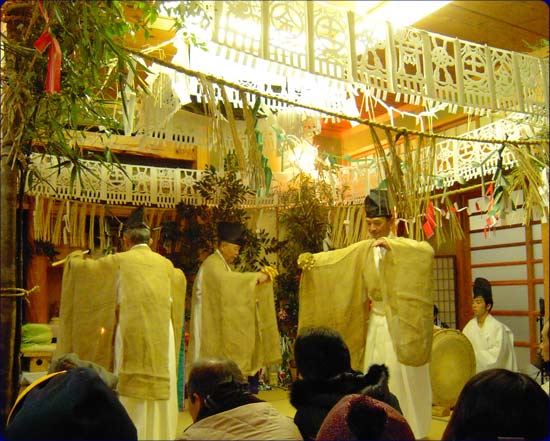
A kagura presented near the town of Takachiho, Miyazaki Prefecture on the island
of Kyushu, Japan, in December 2009 (see Ten Days in Japan, by Ruth Grauert).
Photo by Susan Buirge
|
|
 |
|
 |
|
|
Kagura is a sacred rite danced as an offering to the spirits. Presented at different moments of the agrarian cycle, most prominently in the fall, the spirits are invited to occupy the sacred area and are worshiped with performances of music, song and dance. Most kagura are performed by men only. Boys study the dance in grade school. When they are older and if they elect to continue dancing, they are apprenticed to the performing group. However, there are certain kagura for women.
Susan Buirge has researched kagura since her discovery of these archaic ritual dances in 1993 as artist in residence at the Villa Kujoyama in Kyoto. Living in Japan for the last six years has allowed her personal contact with the inheritors of these dances, and to analyze their construction, which has been established in fixed forms for centuries. As a contemporary dance choreographer she believes that understanding these ancient dance forms can help revitalize contemporary choreography.
Each day the experience of choreography as ritual—based on aspects of Japanese kagura—will be taught in three classes:
- Technique (2 hours): practical experience incorporating gestures and spatial, time, and motion elements common to kagura.
- Theory (1 hour): the components of ritual and art, and of ritualization and choreography.
- Composition (3 hours): choreographic exploration for the realization and presentation of dance compositions (solos and/or duets).
graduated from the University of Minnesota, spent a year at Julliard, and danced in the Nikolais Dance Theater from 1963 to 1967. She emigrated to France in 1970 where, supported largely by the French Government, she toured and taught throughout Europe, Africa, Asia, and Canada. From 1992 to 1998 she worked with gagaku music and Japanese contemporary dancers in Kyoto, Japan. From 2000 to 2006 she directed the Center for Choreographic Research and Composition, a program for contemporary dance at the Royaumont Foundation in France. Susan emigrated to Japan in 2008 to direct Plateforme, a research project on the ancient ritual dances of Asia and their possible relationship to contemporary choreography. Susan has published four books and choreographed over 96 works for theater as well television; a number of her works have been made into films. She is married to theater producer Jiro Nemoto, and lives in Kitakyushu, Japan.
|
|
|
|
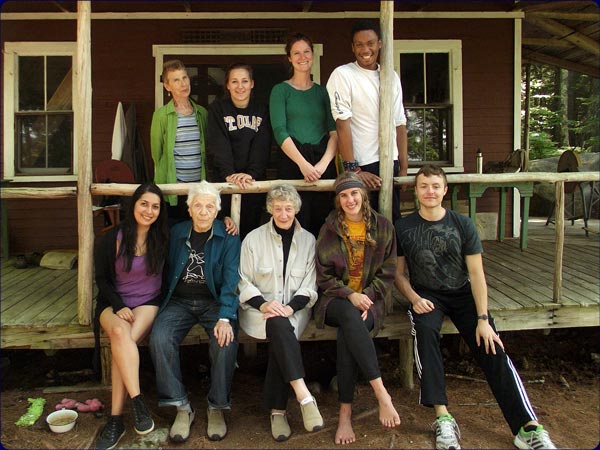
Back row: Mary-Jean Cowell, Harper Foote, Megan Mizanty, and Jmaw Moses
Front row: Anabel Sagrero, Ruth Grauert, Susan Buirge, Alli Bradley, and Michal Freriks
|
|
|
|
|
|

Member of the early Nikolais Dance Theater to receive highest French honor
The President of France has nominated Susan Buirge to the rank of Chevalier (Knight) in the National Order of the Legion of Honor—the highest distinction of France.
The nomination was proposed by the Minister of Foreign Affairs, in particular for the work she has done to further Franco-Japanese relations.
In October, an official ceremony will be held at the French Embassy in Tokyo where the Chevalier insignia (image left) will be presented by the Ambassador. The ceremony will be followed by a reception for some 50 invited guests in the garden of the Embassy.
|
|
|