 |
|
Glass as Performative Practice
Video and Lecture by Alexander Rosenberg
July 1, 2016, 7:30 p.m., Bearnstow Main Hall
(admission free)
Download flier (PDF) |
Alex Rosenberg has studied at the Pilchuck Glass School, the Haystack Mountain School of Craft, and the Corning Museum of Glass. He holds a BFA in Glass with a concentration in Creative Writing from the Rhode Island School of Design, and a Master of Science in Visual Studies from the Massachusetts Institute of Technology Visual Arts Program. He currently lives in Philadelphia.
I work with a wide variety of materials and processes, but my approach to all of them comes from a studio practice based in a single material, glass. It is with this narrow area of expertise that I enter into a larger conversation with other disciplines and media. Glass is both archaic and high-tech; it records sound, movement, and other forms of information; it is a material well suited to preservation and observation, proto-cinematic devices, and fiber-optics—a literal window and a figurative one to the digital world behind the screens of our electronic devices.
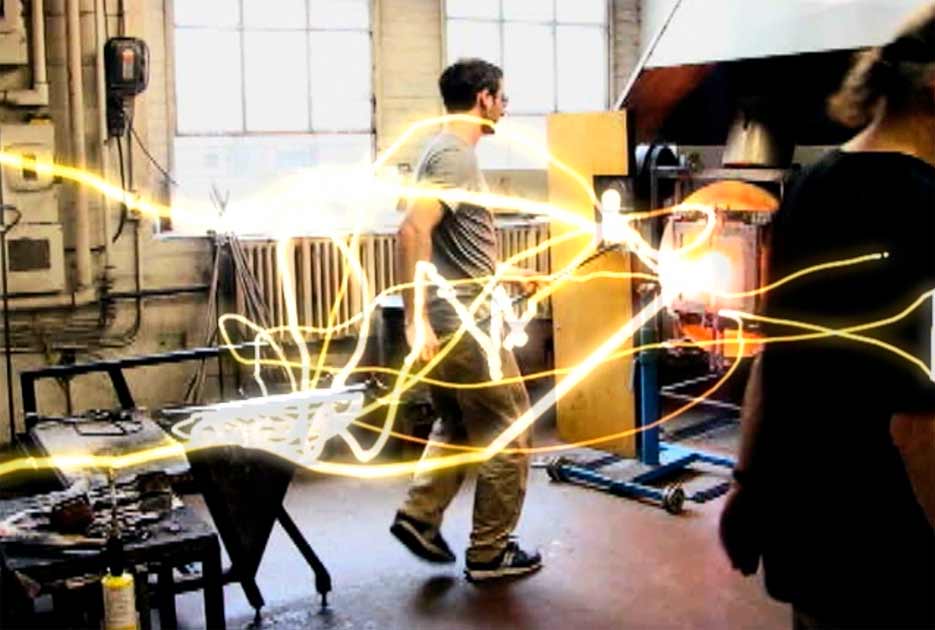
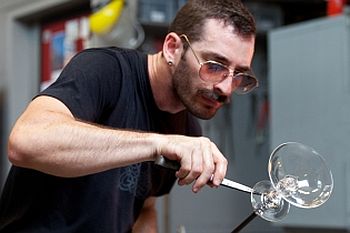
I produce traditional vessels as part of this practice, reverse engineered from photographs in books and objects that I find in museums, but the results are not present in my body of work. It is the performance of making that I am more interested in. Glass vessels are a tangible recording of a body moving through space and to make them is a form of historic research. To make them perfectly is to reenact a series of movements made by another person hundreds—sometimes thousands—of years ago. This kind of closeness is appealing to me and is the basis of my interest in history.
 |
|
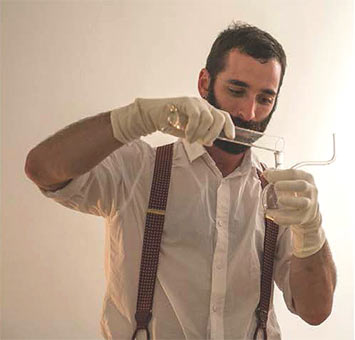 |
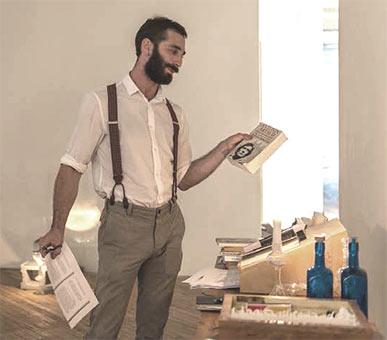
Hyperpyrexic (2014) — hand-blown soda-lime and borosilicate glass, etched found sheet glass, collected bound and photocopied texts making up “fever library,” candles, nichrome wire, Variac (variable autotransformer), mild steel, plywood, electronic components, dry gin, wintergreen oil, shadows, heat.
I came to the gallery to perform the distillation process in the evenings weekly. This shifted the space to a laboratory-like forum for discussion. Curious discussions arose about the work, the processes, the works in the library and other facets of studio practice |
|