None of the information that appears in this article would have been remotely possible without the talents, generosity and friendship of Emma Lew Thomas. As I indicated (see An Addendum—Emma Lewis Thomas), Lew and I were both at the Wigman Schule in Berlin in 1955–56, I as a Fulbright Scholar and Lew as a dancer in Wigman’s choreography. I stayed a year; she stayed five. And, as you see by the photos, she was in the performance of Mary’s Sacre du Pintemps in 1957 as one of the prime figures. In the spring of 2014, I invited Lew, who now summers on her ranch in Montana, to come to Salt Lake City to attend a Ririe-Woodbury Dance Company performance, and she arrived with two delightful German friends—Arnd Wesemann and choreographer Helena Waldeman. That was the beginning of the article written by Arnd, editor for TANZ magazine. When it was published, Lew graciously agreed to translate the article into English for the Bearnstow Web site, and she has done a magnificent job. Her goal was not to alter, but to keep the essence of Arnd’s original thoughts in her translation. It has been a fabulous experience for me. Thanks Lew!!! And also thanks to Ruth Grauert and Jim Van Abbema for making it available to all of us. —Joan Woodbury
 Jena C. Woodbury, Executive Director, 801.297.4234
Daniel Charon, Artistic Director, 801.297.4238 Alberto del Saz, Co-Artistic Director of the Nikolais/Louis Foundation for Dance, is responsible for the reconstruction of all Nikolais works for the company. |
alwin nikolais
By Arnd Wesemann, Tanz magazine, July 2014, pp. 58–61
Translated by Emma Lewis Thomas, October 2014
Who still remembers this fantastic dance magician from the USA?
Only a few older women. Visiting them was… Arnd Wesemann.
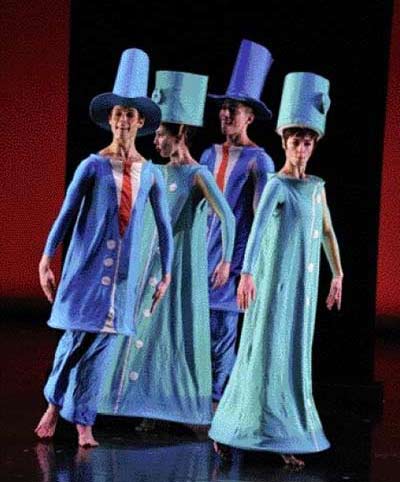 “Clothes” from Kaleidoscope (1956) Ririe-Woodbury Company reconstruction, 2009, funded in part by the National Endowment for the Arts Photo: Michael Manning |
|
“Somewhere it’s got to be here,” exclaims Joan Woodbury. It once stood back of Main Street, with its smart shops, the small boutiques and the Egyptian Theater that actually looks Egyptian, that in winter houses the famous “Sundance Film Festival”: the dance studio, where Alwin Nikolais and Joan Woodbury held summer workshops together, created and trained dancers together in the summer months. That was in the 1960s. …Was it perhaps there, where now a restaurant parking lot has taken over? …Or here, where the grade school has added on a wing? About this loss she looks graciously away: “Nothing remains the same,” says the lady with the fashionably short silver hair. “Every generation makes something new. Why would you need a dance studio here…?”
The Well-hidden Inheritance
For many years Joan Woodbury and Shirley Ririe have had their own dance company, the Ririe-Woodbury Dance Company down in Salt Lake, this opulent clean city. When pedestrians cross the quiet streets of the city, they take a small red flag from a basket and wave it as they cross to the other side. Around the traffic-protected idyll in the mountain range are located countless mines that emit poison from producing gold, copper, and other metals. Over the Great Salt Lake hovers a sulphur smell. The wide landscape belongs to the Latter Day Saints. The Mormons are known for maintaining their family archives in this mountainous location. They do not exhibit their inheritance, they hide it well.
| |
|
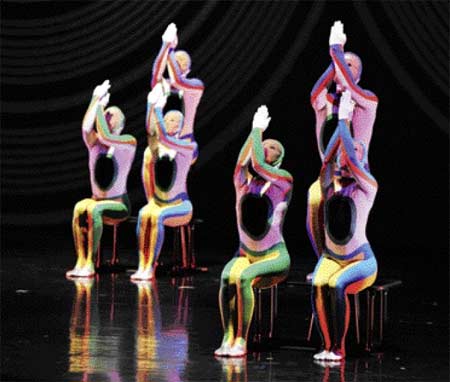 Temple (1974) Ririe-Woodbury Company reconstruction, 2011 Photo: Michael Manning |
And it is here that the existing inheritance of Alwin Nikolais is kept alive. The “Father of Multimedia Theater,” whom Americans simply call “Nik,” died in 1993. His writings and other artifacts are collected at Ohio University. The ultimate interpretation of his works was assumed by Ruth Grauert, who lives in a residence for dancers in a hamlet called Bearnstow in Mount Vernon, Maine, from which the 95-year-old still puts out on-line the “Beanstow Journal” to honor him. Since 1942 this lighting designer was a close collaborator with Nikolais, a person respected in the dance scene of America, the “sculptural artist of dance,” as the Italian journalist Francesca Pedroni called him in a rare monograph.
Born in 1910, Alwin Nikolais studied composition, began his career by accompanying silent films on the organ. Every kind of modern art fascinated him. He buried himself in Einstein’s theory of relativity as well as Mary Wigman’s Expressionistic Dance [Ausdruckstanz]. He researched the brand new practice of electronic music and its accompanying experimental film. At the age of thirty he created, with Truda Kaschmann, his first multimedia choreography, Eight Column Line (1939), seen by Salvador Dali and Léonide Massine. In 1948 in New York he took over the Henry Street Playhouse and installed the Nikolais Dance Theater. These are only a couple of high points. In 1968, in the Théâtre des Champs-Elysées in Paris, Tent became the international breakthrough. The abstract dance pieces of Nikolais were sensational events when you consider the limits of technical processes then available: with rotating play of lights, slide projections, consistent use of self-composed electronic music (Nikolais owned and played the first Moog synthesizer available on the market). The contours of his dancers he transformed into colorful silhouettes, with masks and abstract costumes. Arms and legs shot out in strange “isolations” in all directions: “They were artificial creatures, not from this world, but from Mars,” Joan Woodbury remembered. In 1964, exactly fifty years ago, she and Shirley Ririe founded their own company. Here the two of them still try to keep Nikolais’s dances in repertory today, with currently fourteen works, a tiny selection of the 250 works of the dance pioneer.
| |
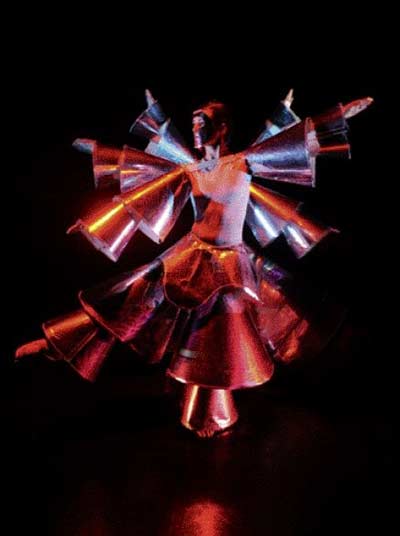 “Carillon” from Liturgies (1983) Ririe-Woodbury Company reconstruction, 2008, funded in part by the National Endowment for the Arts Photo: Fred Hayes |
|
The Rhythmical Machine
The Ririe-Woodbury Company has its home in the modern Rose Wagner Performing Arts Center on Broadway, a wide empty street in Salt Lake City. Sometimes the company performs here; more often they are on tour, to earn money. That Woodbury was asked to work with the Nikolais Company is fortunate for the small group. Since 1931, Nikolais had studied with Hanya Holm, who had disseminated Mary Wigman’s art of dance from New York [to the Far West]. Twenty years later, Joan Woodbury received the first ever Fulbright scholarship granted for dance study, and in 1955, as a highly talented artist, went directly to Berlin to study with Wigman. Through this detour she met Hanya Holm and Alwin Nikolias in Colorado Springs in 1949. By 1964, Nik had been for a long time the star of “psychedelic dance.” In that year, Ririe and Woodbury formed their own company in Utah and were able to win the support of the master (Nik) as a teacher and mentor for their dancers. They lived and celebrated in that studio that we almost couldn’t find in the Park City area. In 2014 it was a large blue building that had been a church.
Today, at 86 years, Joan Woodbury is the youngest and above all the most agile of Nikolais’s followers—not to forget Alberto “Tito” Del Saz, the representative of the Nikolais-Louis Foundation in New York. He re-creates the dances in Salt Lake City; for up to now, only the Ririe-Woodbury Dance Company has been granted the right to present an entire evening of Nikolais’s pieces. For example, consider Temple from 1974: Nine dancers create a rhythmical machine that seems to be guided by a strongly rhythmical organ. “It looks so easy,” says Woodbury, bending over countless photos that she is scrolling on a screen. “But the dancers must count like crazy. Every individual gesture is very carefully set and recorded. It is difficult to teach or learn this choreography, because it doesn’t depend only on the music but also on the lighting design and on the costumes that reflect the light.” Nikolais never “rehearsed informally.” All threads came together even in the studio. Lighting, that today often plays a subordinate role, was for Nik not an element that was added shortly before the premiere. Everything was equally important, a part of the choreography.
| |
|
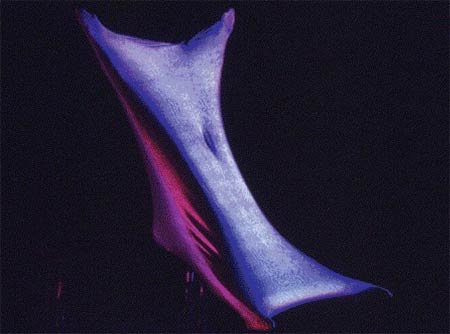 Noumenon (1953) Ririe-Woodbury Company reconstruction, 2003 Photo: Brent Herridge & Associates |
Competing Communication
with Merce Cunningham
Aesthetically, individual progressions of his dance magic are found in the USA today primarily in groups such as Pilobolus and Momix. In Europe his bonbon-colored synthesizer aesthetic was further developed after 1965 primarily by the celebrated Nikolais dancer
|
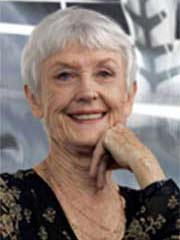 Joan Woodbury |
Carolyn Carlson and Philippe Decouflé. Even today he comes closest to approaching an affinity with the master of technical wonder. In Europe, other than Paris, Nik was known primarily in Hamburg. He greatly influenced Europeans in 1978 as the Founding Director of the Centre National de Danse Contemporaine in Angers, in the no-mans-land between Paris and Brittany, where now, in July 2014, the “World Dance Alliance” will convene. In Angers, the American taught “Decentralization,” as he hesitantly described his dance method. In it, he let himself be inspired by Rudolph von Laban’s geometry of bodily movement, and developed his own “Choreowriting” (Choroscript), which consists of wonderfully beautiful sketches for movement analysis. In 1981 he gave the space in Angers to the German-American Viola Farber. This dancer, who died in 1998, introduced Cunningham’s technique, which the youngest leader of the Dance Center, Robert Swinson, continues to support today. And Nik? Since then, practically no one in Europe remembers him anymore.